

I have started to work on a new mug form. Its
kind of Ruggles&Rankin/Clary
Illian/
Sequoia Miller inspired. This mug form is pretty different than the mugs I have been making recently (Simon's mugs). I just got back from a trip, which I will write all about soon (I promise Ryan). Anyways, this trip made me think a lot about the pots I am making and the pots that I want to make. Being
surrounded by a lot of good pots and potters made me think a lot about what makes a good pot. This is
kind of an unanswerable question but it is very thought provoking.
The point that I am trying to get at is that I am back in a very "investigative" place in making pots. I am trying lots of new things and following lots of new influences. I am very excited about these new influences and new ideas to try out. This has caused me to get back into the mode were all I want to do is make pots. I am trying new things with clay bodies and also I have been throwing almost everything off the hump. I was inspired to throw and trim off the hump by Simon. He throws most of his pots off the hump, including plates.
Throwing off the hump can be difficult to begin with but provides many advantages in my opinion. There are the obvious benefits of not having to make individual balls of clay and increasing how fast you can make pots. But for me one of the biggest things is that the pot is raised up on a pedestal of sorts (the hump). This allows you to see the pot from a more objective angle while you are throwing it. I also like the freedom of making many pots quickly and I also like the
process and the marks left from cutting the pot off the hump.
Trimming off the hump (soft clay chuck) allows you to keep the pot steady without using wads and
without flattening the rim by sticking it to the wheel head. The pot also moves around a little which allows you to have a little more movement in your pots.
I
believe that working in this way, using the
processes described above, allows me to move closer to making the pots that I like. I have a lot more ideas I am currently working on and I will share them with you soon.
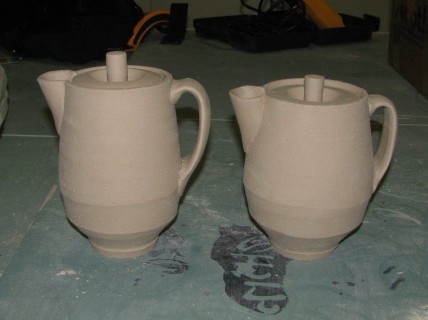 I am finally getting to a point with these lidded pitchers where I feel like I know what I want from them. Meaning that I feel that I have worked out enough of the details so that I can actually be somewhat satisfied with them. This does not mean that they are done evolving, It just means that they are to a point were I will fire them.


 The spout and lugs on this teapot help to
 I have been working on the same mug form and made a few changes. I changed the handle by making the bottom attachment similar to the top. I also made the handle a little bit thicker and wider. I really don't like small skimpy handles and I felt that the previous ones were a little thin for my liking. I have also been working more with throwing these off the hump. I found that I would cut them off so that the bottom was very thick. Since I do not want to trim these this was a problem. I think judging the thickness of the base will come through practice more than anything but I have definitely been paying more attention to it.
  I want the handles to taper to both ends. I want the bottom attachment to be the thickest and significantly larger than the top attachment.
 I have also been working on a new yunomi form. This form is kind of inspired by a Michael Simon cup that I saw at Guillermo Cuellar's house. I think that it is a very interesting form with a lot of potential. My cups are definitely still in a very rough prototype stage but I am interested to see how they work out. I like how the foot kind of stands out in the profile of the cup.


